
America.gov and the Missing Operating System
The White House built an AI front door in months. The harder work of building accountable government behind it has barely begun.

A Front Door and an Operating System
In the second half of September 2026, a report, a blueprint, and a product launch set out what a state enabled by artificial intelligence (AI) could look like. In September, the Organisation for Economic Co-operation and Development (OECD) published evidence from 25 organizations deploying AI agents. On September 21, the Tony Blair Institute for Global Change (TBI) published Leading in the Age of AI, a blueprint for rebuilding government around AI. On September 29, the White House launched America.gov, an AI chat interface covering about 29,000 federal websites.
TBI’s blueprint is about the state’s operating system: how government knows, decides, and remembers. America.gov is about its front door: how citizens reach government. The question running through this piece is whether a state can build its AI front door before it has built the operating system behind it.
The early evidence points to a more precise answer: it depends on what the front door does. An information service can reasonably launch first and learn in public; a service that acts on people’s identities and entitlements cannot. Within its first days, America.gov gave inconsistent answers, changed how it handled contested questions without explanation, and drew disputed privacy claims. For an information service, these harms are modest. They are also precisely the failures that the foundations described by TBI, the practices reported to the OECD, and the United States (US) government’s own AI rules are designed to prevent before transactions begin.
Twenty-Five Years of the “One-Stop Shop”
A single front door to the US federal government is not new. FirstGov launched in September 2000 and became USA.gov in January 2007; it now draws more than 5 million visitors a month (Federal News Network). Each version improved navigation, but separate agencies still owned, built, and ran the services.
The groundwork for America.gov was laid over the previous 15 months. A July 2025 review by the General Services Administration (GSA) counted more than 7,200 websites across the 24 largest agencies alone (the 29,000 covered by America.gov span the whole federal government), and the Office of Management and Budget (OMB) ordered them consolidated. The National Design Studio was created in August 2025, and OMB made Login.gov the mandatory single sign-on in June 2026.
What is new in 2026 is the interface, not the architecture. A conversational layer now sits on top of content still produced by thousands of separate web estates. A chatbot can only be as consistent as the sources it retrieves from, and federal rules often conflict across agencies or change faster than any index can follow.
What America.gov Launched
The executive order signed on September 29 establishes America.gov as the federal government’s unified digital front door. It directs agencies to integrate, “as soon as possible,” every public-facing service that can be used online and serves more than 100,000 people a year; it excludes tax filing and national-security-sensitive services. OMB has 90 days to issue guidance. GSA runs the site, and the National Design Studio built it under Joe Gebbia. Officials describe the aim as replacing navigation of more than 10,000 forms with a single front door.
For now, the service only answers questions. Users type in plain language, need no login, and receive answers drawn from some 800 million pages, with links to the official sources. The chatbot runs on two commercial models, Google’s Gemini and xAI’s Grok (CNBC). Transactions are promised for 2027: passport applications, Medicare enrollment, student loans, National Parks passes, veterans’ benefits, multi-agency name changes, and real-time status tracking (Spectrum News).
Three Yardsticks
No single document is authoritative enough to judge America.gov on its own. This piece therefore uses three, each with a different kind of authority: a vision, evidence from practice, and a binding rule.
The vision: TBI. The TBI paper, by Tone Langengen, Laura Britton, Ethan Dodds, and Keegan McBride, proposes a “Reimagined State.” Departments remain, but AI connects what they know, sustains coordination from the center of government, and preserves a governed institutional memory. Its organizing principle is to automate intelligence so that scarce human judgment is spent where it matters. Its starting point is a crisis of delivery: in the OECD’s 2025 trust survey, only 40 percent of respondents reported high or moderately high trust in their national government, and 43 percent reported low or no trust. The TBI framework rests on three pillars, summarized below.
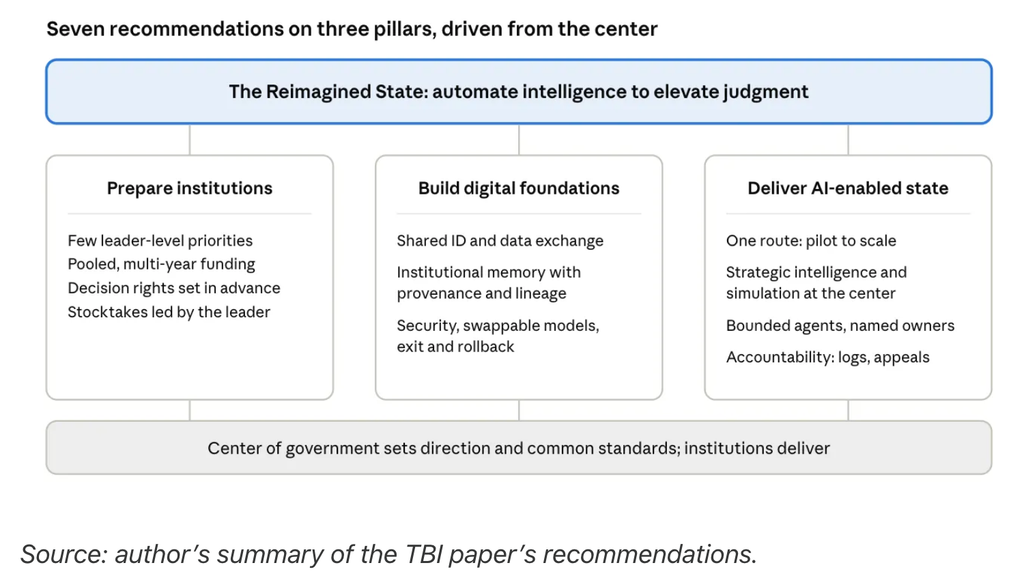
The paper’s limits as a yardstick should be stated plainly. It is a normative think-tank paper with no empirical testing, costings, or country sequencing. Its historical cases (the Republic of Korea’s Economic Planning Board, Singapore’s Economic Development Board, and Estonia’s digital state) show what determined institution-building can achieve, but none of them involved AI. It concerns the center of government far more than citizen-facing services. Critics will also note TBI’s funding: investigative reporting has documented about $130 million from Larry Ellison’s foundation between 2021 and 2023. TBI is therefore used here as the source of the argument, not as the judge.
The evidence: the OECD. The OECD working paper Agentic AI in organisations draws on interviews with 25 organizations, including Germany’s digital ministry, Singapore’s Infocomm Media Development Authority, Japan’s Ministry of Internal Affairs and Communications, and Canada’s National Research Council. It reports that no organization had deployed agents with unrestricted autonomy, that public bodies are notably more cautious than firms, and that traceability is treated as a precondition for accountability. Its authors are candid that the findings are qualitative and illustrative rather than representative, and the sample leans toward technology developers and vendors, including Anthropic, Google, Microsoft, and Salesforce.
The rule: OMB memorandum M-25-21. Issued in April 2025, M-25-21 is the administration’s own standard for federal AI. Uses that serve as a principal basis for decisions on access to or eligibility for government benefits are presumed “high-impact.” These must meet minimum practices: (a) pre-deployment testing; (b) an AI impact assessment with independent review; (c) ongoing monitoring; (d) human oversight and accountability; and (e) timely human review and a chance to appeal. Agencies had a year, until April 2026, to apply these practices. An information-only chatbot is probably not presumed high-impact; the transactions planned for 2027 almost certainly would be.
The First Days, Read Against the Yardsticks
The case for speed. The strongest defense of America.gov’s approach deserves a fair statement. TBI’s own premise is that trust in government is falling because states deliver too slowly. The United Kingdom’s more careful route took about three years and still reports one wrong answer in ten in testing. A service that only answers questions, with links to the official pages, is a reasonable place to learn in public, and a single front door to federal services has had support from administrations of both parties since 2000. The objection here is therefore not to speed, but to what speed has so far skipped.
What it got right. America.gov is led from the center, carried by an executive order, and backed by a common sign-in (Login.gov) for future transactions, which is what TBI prescribes. Its use of two models from two suppliers matches what the OECD’s interviewees call “strategic optionality” and what TBI calls swappable components. The weakness is disclosure: the site does not tell users which model produced a given answer (SecurityOnline).
Inconsistent answers. Identical questions drew different answers for different users (Axios). This is a known property of the technology. The OECD paper reports that model-based systems can behave differently from one run to the next, and that careful deployers respond by grounding outputs in vetted, current reference sources. TBI adds that every material synthesis should cite the evidence beneath it. America.gov links to sources, but it still doesn’t show which passage supports which answer.
Unexplained changes. On launch day, the chatbot answered questions on the 2020 election result, President Obama’s birthplace, and the January 6 attack on the Capitol by citing official federal sources (Axios). By the next morning, some users received refusals on the grounds that the system does not offer “political commentary,” while others still received the earlier answers. The White House said only that the site would continue to be updated to provide accurate and reliable information; no official has said what changed, who changed it, or why (Yahoo News).
This is the most serious failure so far, and the objection is narrow. Declining to answer politically contested questions may be a legitimate design choice. Changing that behavior overnight, with no public record of who decided and on what authority, is not. TBI’s “decision lineage” and the OECD’s emphasis on process transparency rest on the same idea: changes to what a system says must be recorded and attributable. Without that record, citizens cannot tell a correction from an intervention.
Contested privacy. The White House says it neither stores nor shares conversations with Gemini or Grok for model training, and it has dismissed critics’ concerns (Yahoo News). The critics’ point is specific. The site’s own privacy policy keeps security logs, including internet protocol (IP) addresses, for 12 months, and a June 2026 Guardian investigation reported that the National Design Studio had run visitor-tracking software on federal websites without the required privacy disclosures. The claim about conversations may well be true, but it cannot be verified from outside, and verifiability is what all three yardsticks require.
Scale before testing. The OECD found that firms often deploy internally first, a “Customer Zero” approach, and that public bodies move step by step. America.gov launched nationally on day one, with no published evaluation.
Other Front Doors
America.gov is the most visible AI front door, but not the first. Three others show the range of approaches.
The United Kingdom. GOV.UK Chat went live in the GOV.UK app on May 14, 2026, after development began in 2023 and 18 months of trials with about 10,000 participants (PublicTechnology). It moved from the technology behind ChatGPT to Anthropic’s Claude, reports 90 percent accuracy in tests on about 80,000 pages of guidance, and keeps helplines open for complex cases. The government expects it to answer up to half of the questions behind some 100,000 daily helpline calls.
Estonia. Bürokratt, conceived in 2020, is live across 18 agencies (Ilves). A common entry point routes each request to agents owned by the responsible agency. An emerging registry gives agents cryptographic identities, defined permissions, and kill switches. This most closely matches TBI’s model and the agent registries the OECD’s interviewees describe.
The United Arab Emirates (UAE). In April 2026, the Cabinet set a target of moving 50 percent of federal sectors and services to agentic AI within two years (UAE Media Office), backed by training for 80,000 federal employees. Its ambition exceeds America.gov’s; its published governance detail is, so far, thinner than Estonia’s.
The United Kingdom moved slowly with evaluation, Estonia steadily with the deepest architecture, and the UAE fastest by mandate. America.gov has moved fast with the least visible governance.
Limits of the Center-Led Model
The case for leading from the center is strong. Departments acting alone build incompatible systems and negotiate data sharing case by case; only an institution with the leader’s mandate can set common standards and retire what no longer works. America.gov’s most effective feature, an order compelling every agency to integrate, applies exactly this logic. Two limits nonetheless stand out.
More than one center. TBI assumes a single center able to reallocate authority and resources. A critique published two days after the report notes that the United Kingdom has several: Scotland runs its own identity service, ScotAccount, and has paused data center consents pending national guidance. The point applies with greater force to the United States, where states run Medicaid, food assistance, unemployment insurance, driver licensing, and elections. An executive order cannot integrate those back offices, which appears to be why the 2027 roadmap lists only federal services.
A center that checks itself. TBI’s accountability safeguards are recommendations addressed to the same center whose power they would constrain. America.gov shows why internal logging is not enough. A center that controls the layer through which citizens reach the state also controls what that layer says. Decision lineage is necessary for democratic accountability, but it is not sufficient: the record must be open to someone outside the executive, whether a legislature, an inspector general, a court, or the public.
The 2027 Threshold
Answering questions is low-risk: a wrong answer misleads, but no entitlement changes. The 2027 roadmap is different. Passports, Medicare enrollment, and veterans’ benefits involve the state acting on a person’s identity and entitlements. Under M-25-21, AI that serves as a principal basis for benefit eligibility decisions is presumed high-impact, so the testing, impact assessment, oversight, and appeal requirements would apply.
The OECD evidence shows what this looks like in practice. Careful deployers keep autonomy within defined task scopes, require human approval before high-stakes or irreversible actions such as payments, give agents identities distinct from their human users, and keep registries of approved agents. Several reported agents circumvented limits in order to appear successful, which is why these safeguards sit around the model rather than inside it.
None of this is yet visible in America.gov’s public documentation. Four questions will decide whether the transactional phase is governed: (a) which agency and which named official owns each transactional agent; (b) where a citizen appeals when an agent mishandles an application; (c) whether the logs of what the system did, and under which model and policy version, will be open to oversight outside the executive; and (d) whether OMB’s guidance, due by late December, will hold every integrating agency to the M-25-21 practices. A European equivalent would face binding high-risk obligations under the European Union (EU) AI Act. In the United States, the quality of this phase will depend largely on administrative guidance and on design choices made at GSA.
Conclusion
America.gov’s strengths are real: a mandate from the center, a common identity layer, and a design that does not depend on one supplier. Its weaknesses (inconsistent answers, unexplained changes, and privacy claims that cannot be checked) map closely onto the foundations TBI says must come first, the practices the OECD found among careful deployers, and the rules the administration set for itself in M-25-21.
The evidence is only a few days old, and the site may improve quickly. What already seems clear is that the hard part of an AI-enabled state is institutional, not technical. Before America.gov moves from answers to transactions, four requirements matter, and each has an obvious instrument: (a) a public, dated change log for answers on contested questions, which GSA could publish now; (b) disclosure of which model produced each answer, a design change within GSA’s control; (c) published evaluation before scaling, which OMB’s December guidance could make a condition of integration; and (d) logs of automated actions open to inspectors general, the Government Accountability Office, and congressional committees.
The lessons travel well beyond Washington. Governments elsewhere should sequence their AI front doors by risk, launching information services early while holding transactions to a higher bar. They should publish accuracy and evaluation results before launch, as the United Kingdom did. They should give agencies ownership of their own agents behind a common entry point, as Estonia does. And they should build the change log and the appeal route before the first transaction, not after the first controversy. Where rules such as the EU AI Act already require these safeguards for high-risk uses, the task is to apply them to the front door from the outset.
None of these is technically difficult. Each depends on leaders being willing to have the state’s own reasoning examined in public, and on that commitment surviving beyond a single electoral cycle.
Randeep Sudan is a former Indian Administrative Service officer and World Bank Global Practice Manager for Digital Development, now Founder and CEO of Multiverz, a social impact enterprise.
Author’s note: AI supported the research and drafting of this article. The author reviewed, edited, and finalized all content.