
Beyond the Silicon Mirage
A Sovereign Investment Doctrine for a Multi-Speed Artificial Intelligence World.

National artificial intelligence (AI) strategies across the globe suffer from a profound capital misallocation. Vendor-driven projections claim generative AI will add between $7 trillion and $25.6 trillion to global output. They also forecast that the technology will elevate annual productivity growth by 1.5 to 3.4 percentage points over the coming decade. Mesmerized by these numbers, ministries of finance and industry have stampede-funded a narrow, one-size-fits-all mercantilist playbook. Among the 46 member nations of the Global Partnership on Artificial Intelligence (GPAI) and the European Union (EU), 44 jurisdictions have adopted formal AI strategies. Twenty-one of those nations have elevated domestic AI compute to a dedicated strategic pillar. From Washington and Brussels to Riyadh, Singapore, and Kuala Lumpur, the prevailing orthodoxy is identical: national AI readiness is equated with the brute-force accumulation of imported graphics processing units (GPUs) and the subsidization of hyperscale data centers.
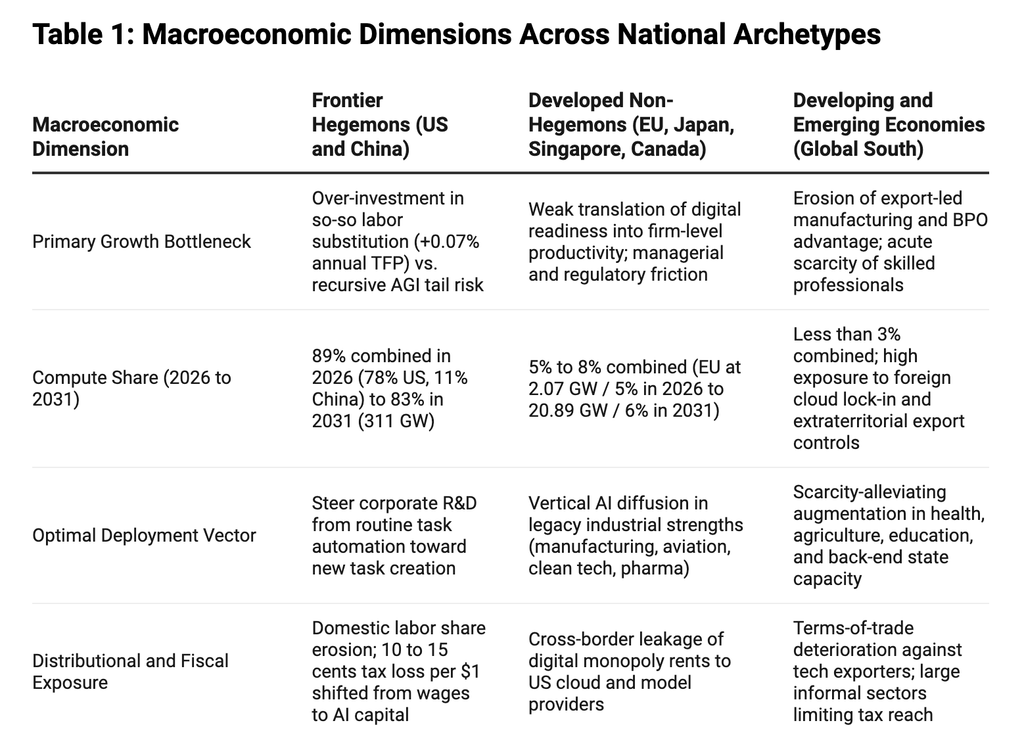
This orthodoxy is strategically naive and fiscally dangerous because it ignores the extreme geopolitical asymmetry of the AI production function. Foundation model training exhibits massive scale economies, causing physical compute and frontier algorithmic rents to naturally concentrate into a superpower duopoly. In 2026, the United States (US) holds 35.28 gigawatts (GW), or 78% of global capacity, while China holds 4.95 GW, or 11%. Together, they control 89% of the world’s 45 GW of live AI compute. This leaves Europe with just 5% (2.07 GW) and the entire rest of the world with 6% (2.70 GW). Even by 2031, when global compute capacity is forecast to reach 373 GW, the US (68%) and China (15%) will retain an 83% share.
When non-hegemon nations pour public treasure into sub-scale “sovereign” training clusters, they mistake hardware purchasing for genuine technological sovereignty. In reality, they remain captive customers of a supply-constrained foreign hardware oligopoly. That supply chain is choked by severe upstream bottlenecks, including high-bandwidth memory (HBM, specifically HBM3 and HBM3E) concentration at SK Hynix and Samsung, as well as three-dimensional (3D) Chip-on-Wafer-on-Substrate (CoWoS) packaging limits at Taiwan Semiconductor Manufacturing Company (TSMC).
To navigate the transition to an AI-driven economy, national policymakers must abandon the cargo-cult pursuit of vanity compute clusters. Instead, they must align public capital with their nation’s structural position in the global AI hierarchy. A rigorous global investment doctrine differentiates across four distinct national archetypes:
- Frontier Hegemons: The United States and China.
- Developed Industrial & Innovation Hubs: Jurisdictions such as the European Union, Singapore’s economy, Japan, Canada, and the United Kingdom (UK).
- Capital-Surplus Swing States: Energy-rich investors such as the United Arab Emirates (UAE) and Saudi Arabia.
- Developing & Emerging Economies: Nations across the Global South, exemplified by India’s mission and Malaysia.
Across all four tiers, policymakers must reallocate capital across four structural priorities. First, they must re-anchor infrastructure from silicon subsidies to electron abundance and modular sovereignty. Second, they must steer deployment from labor-displacing automation toward scarcity alleviation and human augmentation. Third, they must reconstruct fiscal architectures along both source and destination borders. Finally, they must immunize financial and administrative systems against algorithmic monoculture.
1. The Macroeconomic Paradox: “So-So” Automation Versus the Development Double Jeopardy
The foundational error of contemporary AI industrial policy is treating all AI capital expenditure as inherently growth-enhancing, regardless of how or where it is deployed. Within advanced economies, empirical task-based macroeconomic modeling by Daron Acemoglu of the Massachusetts Institute of Technology (MIT) offers a sobering reality check. If AI follows the trajectory of recent digital automation, its macroeconomic dividend over a ten-year horizon will be remarkably modest. Cumulative total factor productivity (TFP) will increase by just 0.55% to 0.71% (roughly 0.07% annually), and cumulative gross domestic product (GDP) will expand by merely 0.9% to 1.8%, even after accounting for an aggressive capital investment boom. Crucially, even under this sluggish growth scenario, automating existing tasks causes GDP to outpace average wages. This shifts national income away from workers and expands the capital share by approximately 0.38 percentage points.
Why do trillions of dollars in private capital expenditure yield such paltry macroeconomic returns? The culprit is the proliferation of what Acemoglu and Pascual Restrepo term “so-so technologies”. Corporations in high-wage economies often deploy costly AI models merely to replace human workers in routine tasks where labor is already relatively efficient, such as replacing customer service agents with automated bots. In these cases, the net productivity gain to society approaches zero, inverting the economics of historic technological revolutions. Furthermore, when generative AI spawns new activities with negative social value, such as algorithmic manipulation or synthetic scams, measured GDP may tick upward even as social welfare declines. At the extreme tail of the distribution lies a different risk: the transformative AI (TAI) or Artificial General Intelligence (AGI) trajectory modeled by Anton Korinek, Joseph Stiglitz, and Phil Trammell. Under that scenario, recursive self-improvement triggers an explosive output take-off once digital compute surpasses biological compute, collapsing the marginal value of human labor toward zero.
For developing and emerging economies, the macroeconomic paradox takes a starkly different form. As Korinek and Stiglitz demonstrate, labor-saving advances in AI threaten to undo fifty years of globalization gains. By making robotic and cognitive automation cheaper than offshoring, AI erodes the developing world’s traditional comparative advantage in low-cost manufacturing and business-process outsourcing (BPO). Premature deindustrialization accelerates across the Global South while “superstar” firms domiciled in the US and China extract monopoly rents globally.
Yet developing nations also possess a massive, underexploited upside. Whereas advanced economies often waste AI on “so-so” substitution of abundant clerical labor, developing economies suffer from acute scarcities of specialized human capital. They urgently need more credentialed doctors, agronomists, teachers, and civil engineers. Deploying AI to ease these foundational skill and administrative bottlenecks can generate transformative social returns without displacing existing workers.
2. Infrastructure Priorities: From Silicon Subsidies to Electron Abundance and Modular Sovereignty
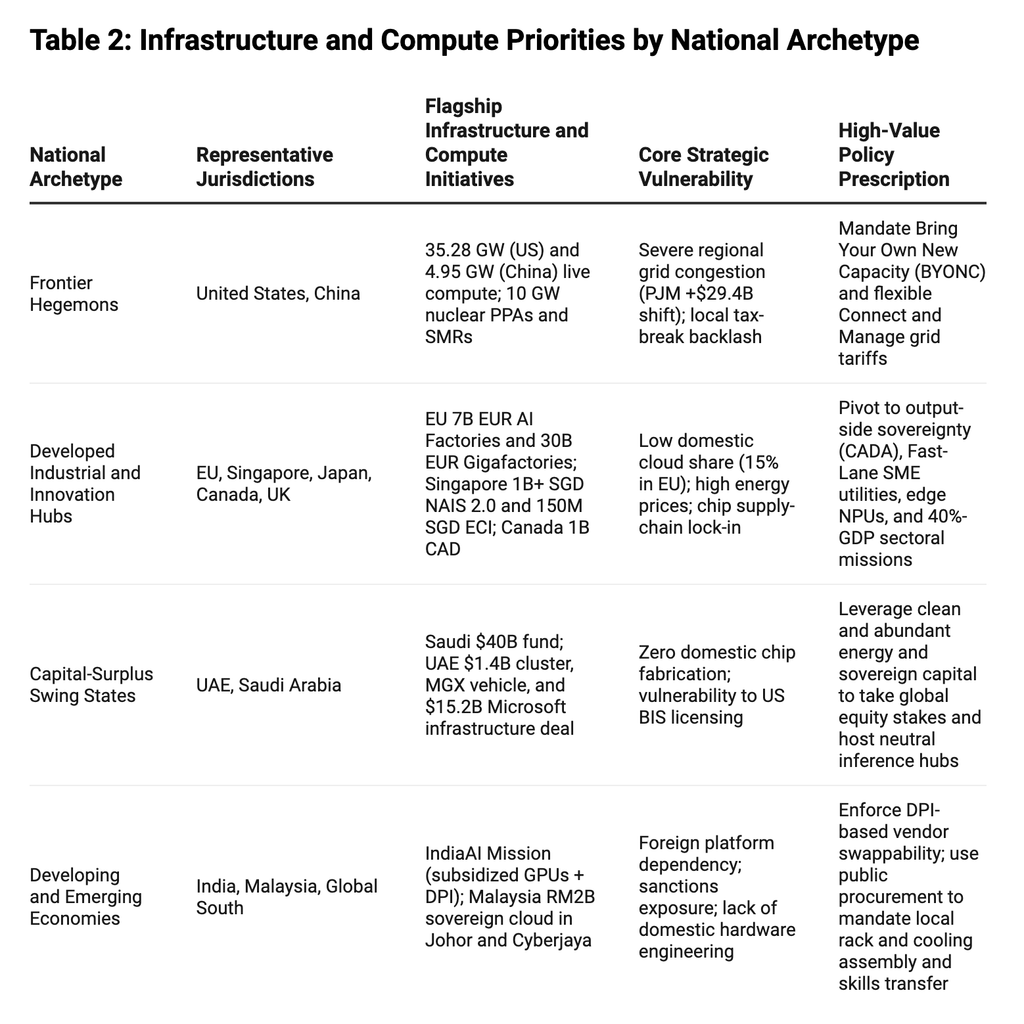
The physical realities of the global AI stack dictate vastly different infrastructure priorities for hegemons and non-hegemons. Within the United States and major data center hubs, unconstrained hyperscale construction has triggered a severe electricity and political crisis. Consider the US Pennsylvania-New Jersey-Maryland (PJM) Interconnection, the regional grid serving 67 million people across 13 states and Washington, District of Columbia (D.C.). Driven by AI, PJM’s data center load is forecasted to grow by over 5,400 megawatts (MW) annually, reaching 29 to 50 GW by 2030. That demand surge caused capacity auction prices to jump more than eleven-fold, rising from $28.92 per MW-day in 2024/2025 to $269.92 in 2025/2026. Prices then hit federal price caps in three consecutive auctions: $329.17 (2026/2027), $333.44 (2027/2028), and $325.00 (2028/2029). Meanwhile, interconnection queue delays and supply chain bottlenecks prevented new power plants from keeping pace. Only 524.7 MW of new generation cleared the July 2026 auction, leaving PJM 6,831 MW short of its reliability requirement. Reserve margins compressed to a precarious 14.7%, shifting $29.4 billion in capacity costs onto ordinary ratepayers across those four auctions.
The political fallout has been immediate. In 2025, PJM wholesale power costs jumped 48.9%, and coal generation rose 19.0%. Households now face $20 to $70 monthly hikes on their utility bills to subsidize facilities that create only 43 to 200 permanent jobs per 100 MW (roughly 0.4 to 2 workers per MW). Voter backlash has already forced states like Ohio to freeze data center tax exemptions.
US hyperscalers have responded by contracting roughly 10 GW of nuclear capacity. Notable deals include Microsoft’s $1.6 billion Three Mile Island restart (835 to 837 MW), Google’s 500 MW Kairos Power agreement for Small Modular Reactors (SMRs), and $4.3 billion in PJM nuclear uprates (890 MW). Similarly, Amazon acquired a ~960 MW Susquehanna nuclear campus and invested $500 million in X-energy SMRs, while Meta signed a 1.1 GW Clinton Power Purchase Agreement (PPA). Yet 10 GW falls far short of the required 85 to 90 GW. Furthermore, regulators like the Federal Energy Regulatory Commission (FERC) have blocked behind-the-meter co-location schemes that shift grid transmission costs onto the public. Hegemons and major hosting hubs (such as Ireland, where data centers consume 22% of electricity) must enforce a strict “Bring Your Own New Capacity” (BYONC) mandate. Paired with flexible “Connect and Manage” grid protocols, BYONC requires developers to fund 100% of incremental transmission upgrades and match new loads with newly built clean generation or automated peak curtailment.
For Developed Non-Hegemons, attempting to replicate US hyperscale training clusters via taxpayer subsidies is a fiscal trap. The European Union’s InvestAI and AI Continent Action Plan aim to mobilize €200 billion. This includes a €30 billion tender launched in July 2026 (€10 billion public, €20 billion private) to build up to seven AI Gigafactories, each housing over 100,000 processors, by mid-2028. Yet among the 101 AI compute centers planned in the EU through 2031, these subsidized Gigafactories rank only 37th in power consumption. Worse, restrictive data localization rules often backfire. They impose heavy compliance costs that only US hyperscalers can easily amortize, leaving European cloud providers with just 15% of their own regional market. Instead of subsidizing raw gigawatt shells, developed middle powers should execute a two-part pivot:
- Market-Correcting Small and Medium-Sized Enterprise (SME) Compute & Edge Inference: Public compute should operate as an agile industrial utility rather than a vanity training cluster. Europe’s €7 billion European High Performance Computing Joint Undertaking (EuroHPC) AI Factories network (19 AI Factories and 13 Antennas) delivers real value when it prioritizes its “Playground” and “Fast Lane” tracks. Those tracks grant domestic startups up to 50,000 GPU hours within four working days. At the same time, European policy should steer private capital away from power-saturated legacy hubs (Frankfurt, London, Amsterdam, Paris, Dublin) toward clean-power-abundant regions in the Nordics, Iberia, and Central/Eastern Europe. Singapore’s National AI Strategy 2.0 (NAIS 2.0) and its 2026 refresh take a similarly disciplined approach. Eschewing autarkic mega-clusters, Singapore committed >1 billion Singapore dollars (S), including a S$ 150 million Enterprise Compute Initiative (ECI) that bundles cloud credits with engineering consultancy alongside strict carbon-budget allocations for green data centers. Meanwhile, industrial powers like Japan, Germany, and South Korea should prioritize on-device neural processing units (NPUs). Capable of 38 trillion operations per second on consumer silicon, edge NPUs run quantized models locally in automotive, robotics, and precision manufacturing without paying recurring US cloud rents.
- Output-Side Sovereignty and Sectoral Beachheads: Rather than chasing impossible “input-side” autarky in chip fabrication, developed non-hegemons should enforce output-side sovereignty. The EU’s proposed Cloud and AI Development Act (CADA) and EU Open Source Strategy advance this goal by establishing four cumulative tiers of sovereignty assurance and local-content rules for critical workloads. Singapore’s 2026 strategy refresh offers the premier model for small open economies. It anchors over 70 corporate AI Centres of Excellence (CoEs) and concentrates national AI Missions on four high-leverage sectors that generate 40% of its GDP. These include connectivity (such as air traffic management for Changi Airport’s Terminal 5 and Tuas Port optimization), advanced manufacturing (AI in Manufacturing, or AIMfg), healthcare, and finance. Singapore also funds regional open-source models like Southeast Asian Languages In One Network (SEA-LION) and Multimodal Empathetic Reasoning and Learning in One Network (MERaLiOn) tailored to Southeast Asian languages.
For Capital-Surplus Swing States (such as the UAE and Saudi Arabia) and Developing Economies (such as India and Malaysia), the optimal infrastructure doctrine combines strategic multi-homing with industrial localization. The UAE does not fabricate semiconductors and faces extraterritorial export-licensing controls from the US Bureau of Industry and Security (BIS). To navigate this, Abu Dhabi has leveraged its Artificial Intelligence and Advanced Technology Council (AIATC), its MGX investment vehicle, a $1.4 billion domestic sovereign cluster commitment, and a $15.2 billion Microsoft partnership (2023 to 2029) to position itself as a neutral, energy-abundant compute hub.
Developing nations without sovereign oil surpluses should follow the World Bank’s World Development Report 2026 prescription. They should avoid expensive foundation-model races and instead pair pooled, subsidized GPU access, exemplified by the IndiaAI Mission, with open-source linguistic layers (like India’s Bhashini platform) and modular Digital Public Infrastructure (DPI) modeled on Aadhaar. Where foreign hyperscalers construct regional data corridors, such as Microsoft, Google, and Oracle in Malaysia’s Johor and Cyberjaya hubs, governments should leverage their sovereign cloud allocations (like Malaysia’s 2 billion Malaysian ringgit (RM) fund). By pairing these funds with South Korea-style public procurement localization mandates, states can require domestic server assembly, rack and cooling engineering, and local R&D workforce transfer.
3. Re-Engineering the Fiscal State: Source Versus Destination Taxation and the Post-Retraining Labor Compact
As AI shifts economic value creation from human wages to machine capital, it strikes at the fiscal foundation of the modern state. In advanced economies like the United States, labor income faces an average effective tax rate of roughly 30% and generates over half of federal revenue. Capital income, by contrast, is taxed at just 15% to 20%. As Daron Acemoglu, Andrea Manera, and Pascual Restrepo demonstrate, this tax asymmetry subsidizes firms to deploy “so-so” automation that replaces workers, depressing labor’s income share from its 1980 level of 63.6%. Worse, as Anton Korinek and Lee Lockwood calculate, every $1 of GDP shifted from human labor to AI capital erodes tax collections by 10 to 15 cents.
How should governments close this fiscal scissors? A strategy relying on source-based corporate taxes, statutory Windfall Clauses, or an eventual ~4% AGI Capital Tax on autonomous compute stocks can only generate substantial direct revenue inside Frontier Hegemons, where frontier labs are legally domiciled. Even within the US, policymakers must avoid the trap of taking direct equity stakes in individual AI firms. Washington should reject both OpenAI’s April/July 2026 proposal to donate a ~5% passive stake to a Public Wealth Fund and Senator Bernie Sanders’s June 2026 American AI Sovereign Wealth Fund Act. The latter would impose a mandatory 50% voting stock tax and 50% board representation. Combining the roles of safety regulator and direct shareholder creates an acute conflict of interest. It also introduces a 2008-style “Too Big to Fail” bailout moral hazard if private AI valuations collapse.
For Developed Non-Hegemons and Developing Countries, where frontier AI services are imported from foreign monopolies, public finance must pivot from source-based production taxes to destination-based access and bottleneck taxes:
- Destination-Based Value-Added Tax (VAT) and Retail Token Taxes: Following Stage 1 of the Korinek-Lockwood framework, non-hegemon states must shift the tax burden from domestic wages to domestic consumption. Governments should levy destination VAT and retail Token/Digital Services Taxes at the point of final consumer usage of foreign AI subscriptions and automated services. By exempting intermediate business inputs and productive robotic equipment through standard input credits, states can capture revenue from cross-border AI deployment without penalizing domestic industry.
- Taxing Immobile Local Complements and Monopoly Markups: Even when algorithm weights live offshore, AI value extraction requires immobile domestic complements. These include spectrum rights, commercial land value, local data repositories, and high-voltage grid connections. Both International Monetary Fund (IMF) research and optimal tax theory confirm that taxing location-specific economic rents and corporate excess markups is non-distortionary under imperfect competition.
- Sovereign Global Equity Indexing and DPI Tax Formalization: While a middle power cannot impose a statutory Windfall Clause on a Silicon Valley lab, Capital-Surplus Swing States and developed economies can still capture global AI upside through capital markets. By investing sovereign wealth into a diversified, non-voting global index of frontier AI developers and semiconductor bottlenecks, nations can mirror Saudi Arabia’s $40 billion international AI strategy. Meanwhile, for Developing Economies burdened by large informal sectors, embedding AI into Digital Public Infrastructure (digital identification (ID), instant payments, and automated procurement auditing) acts as a powerful domestic revenue multiplier. It formalizes tax bases while plugging leakage in public expenditure.
On the labor market front, all country categories must abandon the illusion that traditional, post-hoc retraining programs can absorb AI disruption. Sixty years of evidence from US Trade Adjustment Assistance (TAA) proves that conventional retraining frequently serves as a political excuse to sidestep harm prevention. In practice, TAA failed to reach most displaced workers due to inadequate funding, complex eligibility rules obsessed with preventing “mission creep,” and adjudication delays lasting months or years.
Instead, Frontier Hegemons and Developed Hubs must first equalize tax rates on capital and labor and condition R&D tax credits on human-complementary AI that creates new tasks. When displacement occurs, adjustment assistance must scale automatically through flexible trust funds financed by AI windfalls. Programs should use presumptive eligibility for high-risk occupations, with statutory approval deadlines, and disburse integrated financial and career grants directly to workers before layoff. In Developing and Emerging Economies, rather than copying defensive Western layoff-insurance schemes, labor policy should follow Singapore’s proactive capability model. Through programs like Chief Technology Officer (CTO)-as-a-Service, Industry Digital Plans, and redesigned AI apprenticeships, Singapore tripled its target AI practitioner pool from 4,500 to 15,000. Developing states can apply this same model to deploy AI copilots that upskill community health workers, teachers, and smallholder farmers.
4. Immunizing the System: Algorithmic Monoculture, Shared Compliance Utilities, and Back-End State Capacity
The final pillar of national investment prioritization addresses a dangerous blind spot: governments subsidize private AI diffusion while starving the supervisory infrastructure needed to govern it. In global capital markets, former US Securities and Exchange Commission (SEC) Chair Gary Gensler and the Financial Stability Oversight Council (FSOC) have warned that predictive data analytics and foundation models have evolved from back-office software into an autonomous market activity. Because of extreme economies of scale, the three dominant cloud hyperscalers are tightly coupled with the leading foundation model providers. Invoking the film Her, in which the protagonist discovers his AI operating system is simultaneously interacting with 8,316 other users before going offline, Gensler highlighted a systemic vulnerability: what happens when 8,316 financial institutions rely on the exact same underlying base model or data aggregator?
For both Frontier Hegemons and Global Financial Hubs (such as London, Singapore, Frankfurt, Tokyo, and Abu Dhabi), this algorithmic monoculture is the precise incubator for the financial crisis of 2027 or 2034. If thousands of leveraged non-bank financial institutions rely on identical model weights, a single out-of-distribution shock or aggregator outage will trigger instantaneous, correlated herding and liquidity evaporation. Compounding this fragility is the approaching quantum computing horizon, which threatens to shatter existing cryptographic protections through brute-force computation. Yet regulatory bodies remain severely outgunned. The SEC, for instance, oversees $110 trillion in equity markets and $230 trillion in fixed-income markets with roughly 5,000 employees and 2,000 contractors. Financial centers must urgently fund high-speed Supervisory AI (Supervisory Technology, or SupTech) and enforce fiduciary duties of loyalty so algorithms cannot put platform revenues ahead of clients. Regulators must also mandate model-diversity stress tests, accelerate the migration to post-quantum cryptography, and maintain zero statutory liability exemptions for AI labs.
For Developed Non-Hegemons, however, heavy-handed regulation carries a hidden industrial trap. Empirical research on Europe’s digital transformation demonstrates that complex compliance regimes (such as the EU AI Act, Data Act, and Digital Operational Resilience Act (DORA)) impose high fixed costs. Giant foreign hyperscalers can easily amortize these costs, while domestic SMEs get priced out of the market. To prevent safety regulation from entrenching foreign monopolies, governments must socialize compliance overhead by investing in shared public testing, certification, and reusable auditing utilities.
Singapore’s open-source governance stack provides the global gold standard. It includes AI Verify (an automated testing framework aligned with 11 international governance principles), Project Moonshot (one of the world’s first open-source Large Language Model (LLM) benchmarking and red-teaming toolkits), and a Generative AI Sandbox. Paired with a public “data concierge” and privacy-enhancing technologies (PETs), these public utilities lower the marginal cost of safe AI deployment for startups while building cross-border interoperability with partners like Japan.
Finally, for Developing and Emerging Economies, the World Bank’s World Development Report 2026 underscores a vital truth: the highest-return public investment is not regulating frontier models, but building AI-ready digitized data, staff capacity, and back-end public administration. While deploying AI at the “front end” of government (such as citizen chatbots or unified portals) expands service access, the front door is only as effective as the back office. Governments should deploy vertical, auditable AI tools in the state’s “back end,” such as Singapore’s Pair LLM for civil servants. By automating environmental and grid-permitting reviews, detecting grant and procurement fraud, and tracking displacement in real time, nations can multiply administrative state capacity at a fraction of the cost of physical infrastructure.
5. Strategic Synthesis: The Multi-Tier Policymaker’s Reallocation Matrix
Transitioning from a passive subsidizer of tech monopoly rents to an architect of resilient national prosperity requires tailoring capital allocation to each country’s structural leverage. The matrix below synthesizes this differentiated investment doctrine across all four categories of nations.
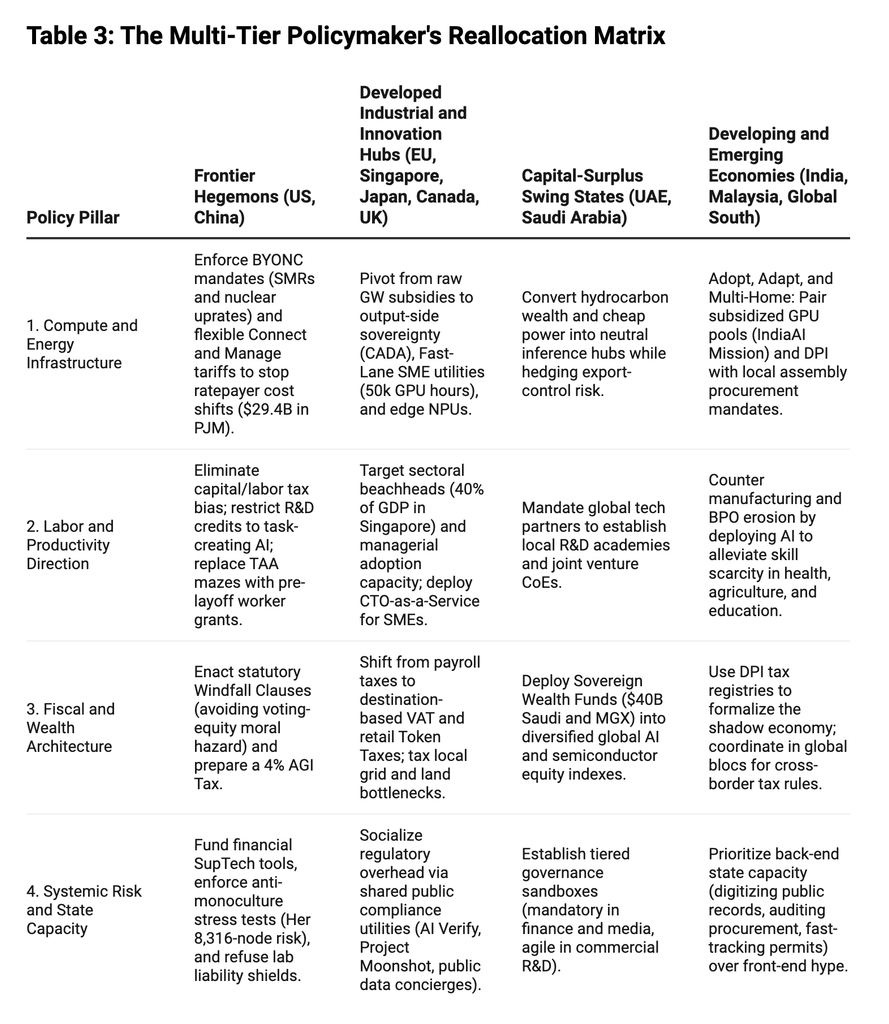
The nations that thrive in the mid-twenty-first century will not be those that burned the most public capital chasing a uniform silicon mirage. Instead, success belongs to states that align sovereign investment with their structural comparative advantage. Hegemon cores must secure clean baseload electrons and source capital taxes. Developed industrial hubs must build output-side sovereignty and shared compliance utilities. Energy-rich swing states should leverage their sovereign capital across global bottlenecks, while emerging economies harness interoperable Digital Public Infrastructure to solve human-capital scarcity. By following this tailored playbook, policymakers in every tier of the global economy can capture the AI dividend without surrendering their fiscal or institutional sovereignty.
Randeep Sudan is a former Indian Administrative Service officer and World Bank Global Practice Manager for Digital Development, now Founder and CEO of Multiverz, a social impact enterprise.
Author’s note: AI supported the research and drafting of this article. The author reviewed, edited, and finalized all content.